Cité Vivante.
A new live-work destination in the heart of an innovation hub.
1 Avenue Pierre Brossolette · 91380 Chilly-Mazarin / Longjumeau
A value-accretive alternative to the Plan A strategy.
Plan A (Boost Campus) is industry-only. Our counter adds housing + civic program on the same basis.
Approved, permitted, and under construction — a conventional tech / light-industrial program that preserves jobs but leaves the surrounding municipalities under-served.
- 54,875 m² of new SDP · 73% industrial, 22% office, 5% commercial
- ~1,300 jobs · a 13% reduction vs. the Sanofi era
- Zero housing · Zero civic program · Zero community activation
- Hits the SRU quota for neither Chilly-Mazarin nor Longjumeau
Same footprint, same basis — reprogrammed to add housing and a public park alongside the retained BSL-2 lab platform, using the Découflé precedent as the approval path.
- Retain the 32,000 m² BSL-2 lab platform · add 350–500 housing units
- 2–3 ha public park + ground-floor services + civic program
- €11.3M–€12.5M stabilized NOI on a €178M–€240M cost basis
- 18–20% levered IRR · 7–10 year hold
Team.



Cité Vivante · Boost Campus Redevelopment · Chilly-Mazarin / Longjumeau
Table of Contents
Property Analysis
Sixteen hectares. Two municipalities. Seven cadastral parcels. One unified land parcel.
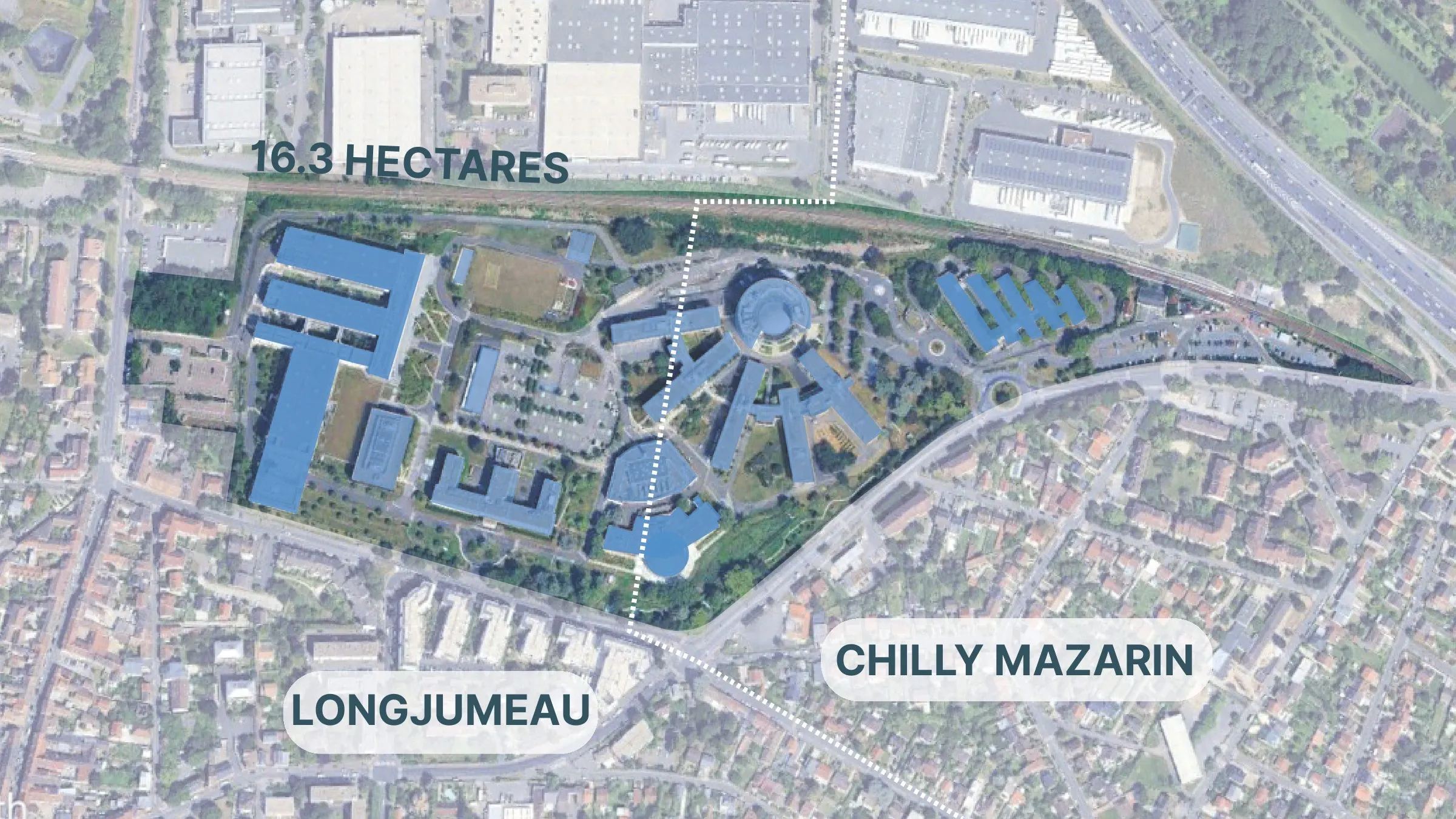
16.3 hectares spanning Chilly-Mazarin and Longjumeau.
A 16.3 ha brownfield site adjacent to the Grande Ceinture rail corridor.
Minutes from Paris-Saclay, Polytechnique, CEA and INSERM.
Four rail and one airport link within 35 minutes.
Site location and regional context.
1 Avenue Pierre Brossolette, 91380 Chilly-Mazarin · Former Sanofi-Aventis R&D campus · GPS 48°42′00″ N / 02°18′ E
| Attribute | Detail |
|---|---|
| Site area | 16.3 ha across two municipalities |
| Municipalities | Chilly-Mazarin (91380) + Longjumeau |
| Unified Land Parcel | 162,829 m² · 7 cadastral parcels |
| Chilly-Mazarin | 000 AC 705 · 63,259 m² |
| Longjumeau | 6 parcels · 98,820 m² |
| Prior owner | AGAZ France Industrial Propco SNC |
| SIRET | 944 154 459 00019 |
| Rail adjacency | Grande Ceinture (future T12 tram) |
| PLU Chilly | Zone Uld · approved 9 Mar 2024 |
| PLU Longjumeau | Zone Ula · approved 24 Sept 2024 |
6 access points · 2 Longjumeau (west), 4 Chilly-Mazarin (east).
Tram T12 along active northern rail corridor · RER C shuttle · bus service.
Paris-Orly 8 km · Paris 20 km.
Brownfield site bordering the Grande Ceinture rail. Village housing to the south, Sanofi HQ to the north.
Two municipalities · one unified parcel · existing utilities and security fabric already in place.
Policy and demographics both point to housing.
Strong demand fundamentals, a municipality under SRU pressure, and a recent approval that proves the pathway works.
- Required: 25% social housing (SRU law)
- Current: ~20%
- Shortfall: −5 pts
Prefect can override local planning if the municipality fails to comply — creating direct incentive to approve compliant residential projects.
- 300 units approved (May/June 2025)
- 30% affordable
- Same municipality (Chilly-Mazarin)
- Industrial brownfield → residential conversion
- VINCI: 167 units under construction, delivery 2027
Confirms the municipality actively supports residential conversion on former industrial sites at scale.
Seven parcels · one unified land parcel · 162,829 m².
Single ownership across seven cadastral parcels in two PLU jurisdictions — one of the largest contiguous redevelopment opportunities in the Vigne aux Loups corridor.
| Parcel | Area | Municipality | Contents | Proposed role |
|---|---|---|---|---|
| 000 AC 705 | 63,259 m² | Chilly-Mazarin | B10, B11, B12 offices; parking silo; landscaped park; 4 access pts | Residential + public park |
| 000 AC 092 | — | Longjumeau | Offices B0/B5/B6, green corridor, restaurant B3, surface parking | Mixed-use core + retained B3 |
| 000 AC 600 | 32,118 m² | Longjumeau | R&D lab complex B9 + B14; underground parking PSO | Retained 32,000 m² labs |
| 000 AC 601 | 6,709 m² | Longjumeau | B9/B14 service areas; western campus road | Retained lab service |
| 000 AC 323 | 9,562 m² | Longjumeau | Northern strip along rail line (T12 corridor) | Transit buffer / cycle link |
| 000 AC 324 | 760 m² | Longjumeau | Rail easement at municipality boundary | Easement retained |
| 000 AC 327 | 268 m² | Longjumeau | Technical easement / access point | Easement retained |
| Total | 162,829 m² | — | Unified Land Parcel across 2 PLUs | — |
Existing improvements assessed for retention or replacement.
| B9 | R&D Labs · biology, chemistry, pharmacology, animal facility. BSL-2 equipped, built ~2010. |
| B14 | R&D Labs / Support · continuation of the B9 platform. Multi-tenant ready. |
| PSO | Underground parking beneath B9/B14. Retained for lab campus. |
| B3 | Restaurant d'entreprise ~1,000 m². Convert to public café / pôle de services. |
| Silo | Multi-story parking structure, Chilly side. Partially conserved. |
Platform total: 32,000 m² BSL-2 labs + ~1,000 m² F&B + ~5,000 m² ancillary.
12 buildings, 1950s–2000s office stock whose structure prevents adaptive reuse.
| Longjumeau · center/west | B0 · B5 · B6 · B8a · B8b |
| Chilly-Mazarin · east | B10 · B11 · B12 (Y-shape + rectangular footprints) |
| Ancillary / utility | D · L · SV (Longjumeau north/center) |
| Security gatehouse | PCS (Chilly east entry) |
Demo total ~68,000 m² · New construction 38,500–52,500 m².
Market Analysis
Life-sciences demand meets a countercyclical construction opportunity.
Retaining a critical lab asset.
The 32,000 m² Sanofi BSL-2 laboratory platform is purpose-built infrastructure that cannot be replicated economically. Retention and repositioning is the optimal strategy.
Cité Vivante adds mixed-use residential, retail, and green space to retained BSL-2 labs — unlike Boost Campus's mono-use industrial approach with zero housing, no public access, and no SRU contribution.
Low supply = low competition.
France is in the deepest construction recession since the postwar era. For a viable project like Cité Vivante, this is an advantage.
- Competing deliveries are collapsing.
- ZAN tailwind: greenfield restrictions make brownfield conversions the preferred path.
- Pent-up demand: years of undersupply create a deep backlog of unmet need.
Projects initiated during downturns benefit from compressed land costs, favorable contractor pricing, and reduced competitive supply at delivery. Cité Vivante's 2029–2031 delivery window allows the market cycle to recover.
Municipality permit activity signals a housing-led approval pathway.
"Full permit registry: under 20,000 m² of industrial permits since 2021. Recent shift to residential · ~10,000+ m² in 2024."
Chilly-Mazarin has granted more residential SDP in a single recent year than industrial permits in the prior three years combined. Market demand and municipal appetite are converging.
Boost Campus's 54,875 m² industrial-heavy program (73% activité) doubles down on a category the municipality has been quietly issuing fewer permits for.
Our 350–500 unit program rides the same residential tailwind evidenced in the cadastre, and satisfies the SRU and PLH obligations Boost Campus leaves unaddressed.
Four converging regulatory frameworks driving Île-de-France housing demand.
SRU housing law (art. 55) requires municipalities over 3,500 inhabitants in Île-de-France to reach 25% social housing. Chilly-Mazarin currently sits at ~20%. Our 20–25% affordable component directly retires the gap. Arizona's plan contributes zero.
The Programme Local de l'Habitat for Communauté Paris-Saclay sets explicit multi-year housing delivery obligations. 350–500 units on one site materially move the municipality's PLH scorecard in a single project cycle.
The Schéma Directeur de la Région Île-de-France (Environnement) requires +10–15% density in the Paris-Saclay arc. Already-artificialized sites like this one are the preferred receiver under the policy. A housing-forward plan answers the regional directive.
The 2021 LawClimat sets a trajectory to ZAN by 2050, halving new artificialization by 2031. The site is already 100% artificialized. Densification here is NOT new artificialization — it is exactly the type of brownfield densification ZAN rewards.
Residential and lab comparables support underwriting assumptions.
| Comp | Location | Year | €/m²/mo | Notes |
|---|---|---|---|---|
| Campus Grand Parc | Villebon-sur-Yvette | 2023 | 18.50 | 140 units delivered |
| Eco. Joseph-Bouchery | Massy | 2022 | 21.00 | Transit-oriented |
| Résidence Saclay Park | Orsay | 2024 | 19.80 | Near research cluster |
| Cité Vivante (UW) | Chilly-Mazarin | 2028+ | 20.00 | 350–500 units |
| Comp | Location | Use | Rent | Notes |
|---|---|---|---|---|
| Genopole | Évry | BSL-2 labs | 350 €/m²/yr | Biotech anchor |
| Paris-Saclay Cancer Cluster | Villejuif | Onco labs | 420 €/m²/yr | PSCC anchor |
| Nexity Aequo | Longjumeau | New resi+retail | 3,200/m² sale | Découflé adj. |
| Cité Vivante (UW) | Chilly-Mazarin | BSL-2 retained | 320 €/m²/yr | 32,000 m² |
Inside the 18.50–21.00 corridor set by 2022–2024 Essonne deliveries. Positioned between Villebon (18.50) and Massy transit premium (21.00).
Set below Genopole (350) and Paris-Saclay Cancer Cluster (420) to reflect Chilly-Mazarin's off-cluster location while retaining the BSL-2 premium.
Both residential and lab rents are underwritten below median comp to preserve occupancy velocity and DSCR coverage at stabilization.
Catalysts.
New rail and tram service fundamentally changes the commute calculus for Chilly-Mazarin.
Paris-Saclay's 1,400+ life-sciences companies are fundamentally undersupplied for walk-to-work housing.
Redevelopment Plan
Three pillars · Innovation, Residential, and the Commons.
Retain what cannot be replicated. Demolish what cannot adapt.
- B9 laboratory platform (BSL-2)
- B3 restaurant / cafeteria
- East parking structure
- East and west surface lots
- All remaining office buildings
- Central surface lot
Three pillars of Cité Vivante.
Retain and extend the BSL-2 science platform.
350–500 homes, ground-floor retail, a public café.
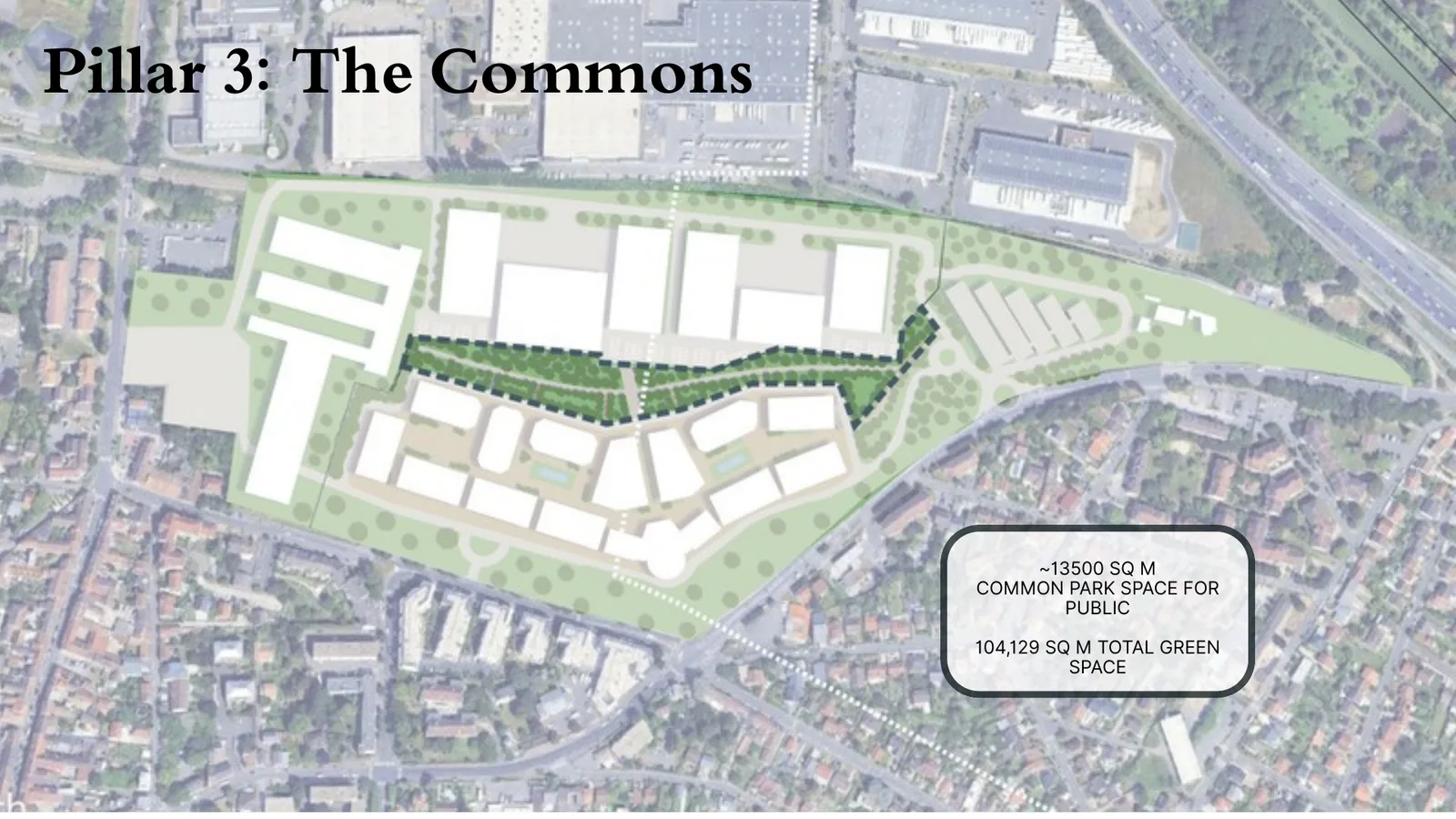
A 2–3 ha public park and 104,129 m² of total green space.
Pillar 1 · The Innovation Sector.
BSL-2 and support labs retained from the Sanofi platform. Multi-tenant ready for Paris-Saclay life-science occupiers.
New build-to-suit light industrial for biotech scale-up tenants, lab support, and clean-room occupiers.
Pillar 2 · The Residential Sector.
B3 adaptive reuse as a public café / pôle de services.
Two-story apartments · 350–500 units across a family-oriented courtyard typology.
Everyday retail and services activating the street frontage and the park edge.
Pillar 3 · The Commons.
A new publicly accessible central park · a civic amenity the Boost Campus plan does not provide.
Total open and planted area across the redevelopment, including courtyards, park, and landscape buffers.

Lab platform retained east · residential and park on the west.

A neighborhood, not a campus.

A 2–3 ha park anchors the commons.
Zoning requires modification. The procedural path is known.
PLU approved 9 March 2024 (Municipal Council). Economic/industrial zone. Permitted: industry, artisanal, R&D labs, offices tied to production, commercial ≤ 5% of zone. Prohibited: standalone residential.
PLU approved 24 September 2024. Mirrors Zone Uld: economic activities, R&D labs, offices and ancillary commercial. Same residential prohibition on a standalone basis.
- To build 350–500 housing units on this site, a legal mechanism is required to override Zone Ula/Uld.
- Three pathways exist. All three are codified in French urban planning law.
- One of them is already live on the adjacent Découflé site — same municipality, same PLU.
- The regulatory risk is known, bounded, and · critically · precedented.
Three statutory pathways evaluated; déclaration de projet recommended.
A public entity initiates creation of the ZAC → formal concertation → municipal council approval → PLU modified via mise en compatibilité → mixed-use becomes permissible.
Cleanest legally. Requires municipality as initiating partner. Timeline 18–30 months.
The exact mechanism currently being used for the Découflé site in Chilly-Mazarin, ~300 housing units on a former industrial site. Public consultation ran June–October 2025.
Fastest proven pathway. Timeline 12–18 months. Directly transferable to our site.
Permanently reclassify from Zone Ula / Uld to a new mixed-use zone. Most administratively heavy. Requires full public inquiry and prefectural coordination.
Right answer long-term; wrong answer for this underwriting. Timeline 24–36 months.
The Découflé precedent.
Same municipality. Same PLU. Same type of brownfield. Already in public consultation.
| Dimension | Site Découflé (live) | Cité Vivante (proposed) |
|---|---|---|
| Promoter | Nexity Héritage | Arizona + independent dev. |
| Site area | 3.65 hectares | 16.3 hectares (9.8 ha developable) |
| Housing | ~300 units + 105-room residence | 350–500 units |
| Affordable | 30% social rental | 20–25% social rental |
| Public facilities | 2,000 m² cultural center | 2–3 ha park + community ctr |
| Mechanism | Mise en compatibilité via déclaration de projet | Same mechanism |
| Status | Public consultation Jun–Oct 2025 | Target initiation Q4 2026 |
Same municipality, same PLU, same MRAe already approved.
- Feb 2025 · MECPLU filing
- Jun–Oct 2025 · Public consultation
- Late 2025 · Council approval
- 2026 · Permits underway
Valuation
A conservative base case built on market-bear yields.
Stabilized Year (Year 5).
| Line Item | Amount (€) |
|---|---|
| Gross Potential Rent | 20,306,797 |
| Other Income | 974,917 |
| Vacancy Loss | (1,437,306) |
| Credit Loss | (293,953) |
| Effective Gross Income | 19,550,455 |
| Operating Expenses | (4,087,089) |
| Net Operating Income | 15,463,365 |
Year-5 stabilized NOI across residential, lab, cafeteria, GFR, and light industrial revenues.
Net of ~7.1% vacancy and 1.4% credit loss against gross potential rent of €20.3M.
OpEx as % of Effective Gross Income at stabilization.
Revenue assumptions by product type.
| Rent Growth | 2.00% |
| Vacancy | 5.00% |
| Credit Loss | 2.00% |
| Exit Yield | 6.00% |
| Absorption | 2 Yr |
| OpEx % EGI | 25.00% |
| Yr 1 €/m² | €300 |
| Rent Growth | 2.50% |
| Vacancy | 8.00% |
| Credit Loss | 1.00% |
| Exit Yield | 6.75% |
| Absorption | 1 Yr |
| OpEx % EGI | 20.00% |
| Yr 1 €/m² | €140 |
| Rent Growth | 1.50% |
| Vacancy | 5.00% |
| Credit Loss | 2.00% |
| Exit Yield | 7.00% |
| Absorption | 1 Yr |
| OpEx % EGI | 25.00% |
| Yr 1 €/m² | €120 |
| Rent Growth | 1.00% |
| Vacancy | 8.00% |
| Credit Loss | 3.00% |
| Exit Yield | 6.00% |
| Absorption | 1 Yr |
| OpEx % EGI | 25.00% |
| Yr 1 €/m² | €120 |
| Rent Growth | 2.50% |
| Vacancy | 8.00% |
| Credit Loss | 1.50% |
| Exit Yield | 6.50% |
| Absorption | 1 Yr |
| OpEx % EGI | 20.00% |
CapEx Budget.
| Component | Hard Cost/m² | Soft Cost/m² | Gross Building Area (m²) | Total Cost |
|---|---|---|---|---|
| Demolition | €50.0 | — | 80,000 | €4,000,000 |
| Park | €150.0 | €22.5 | 104,129 | €17,962,253 |
| Residential | €2,200.0 | €440.0 | 32,000 | €84,480,000 |
| Lab | €300.0 | €90.0 | 47,320 | €18,454,800 |
| Retail · Cafeteria | €1,400.0 | €210.0 | 4,697 | €7,562,170 |
| Retail · Ground Floor | €1,500.0 | €225.0 | 16,000 | €27,600,000 |
| Industrial | €1,800.0 | €270.0 | 19,600 | €40,572,000 |
| Total | — | — | 303,746 | €200,631,223 |
Financing structure.
| Loan Type | Deferred Payment |
| Term | 18 Months |
| Interest Rate | — |
| Debt to Cost Ratio | — |
| Loan Size | €14,000,000 |
| Loan Type | Construction Loan · Interest Only |
| Term | 5 Years |
| Interest Rate | 5.50% |
| Debt to Cost Ratio | 65.0% |
| Loan Size | €123,683,056 |
Sources and Uses.
| Upfront | Future | Total | |
|---|---|---|---|
| Debt | €14.0 M | €123.7 M | €137.7 M |
| Equity | €11.9 M | €105.9 M | €117.8 M |
| Total Sources | €25.9 M | €229.6 M | €255.5 M |
Upfront: 54% debt / 46% equity · Future: 53.9% debt / 46.1% equity · Total stack 53.9% debt / 46.1% equity.
| Total | % of Total | |
|---|---|---|
| Land Cost | €24.0 M | 9.4% |
| Debt Origination | €3.7 M | 1.5% |
| Interest Reserve | €25.96 M | 10.2% |
| Transaction Cost | €11.5 M | 4.5% |
| Construction Budget | €190.3 M | 74.5% |
| Total Uses | €255.5 M | 100.0% |
Return summary · conservative base case.
Stabilized exit at end of Year 5.
Stabilized NOI divided by total project cost.
Cash yield on equity at stabilization.
Weighted exit multiple across revenue streams.
| Year 6 NOI | €15,791,717 |
| Reversion Value | €240,050,825 |
Base-case equity multiple.
Conservative base-case levered IRR.
Unlevered project IRR.
Our underwriting pairs conservative rents with exit yields 100 bps above the current market. In any scenario where the market yields reflect true pricing, returns outperform the case presented.
Levered NPV & Equity Multiple · Weighted Exit Yield × Revenue Growth.
Market base case (5.40–5.90%) vs. our base case (6.15–6.90%, market + 100 bps).
| Levered NPV (18% discount rate) | |||||||
|---|---|---|---|---|---|---|---|
| Rev Growth \ Exit Yield | 5.40% | 5.65% | 5.90% | 6.15% | 6.40% | 6.65% | 6.90% |
| 1.60% | 4.77 M | (0.38 M) | (5.10 M) | (9.44 M) | (13.44 M) | (17.13 M) | (20.56 M) |
| 1.90% | 6.90 M | 1.67 M | (3.13 M) | (7.53 M) | (11.59 M) | (15.35 M) | (18.83 M) |
| 2.20% | 9.05 M | 3.73 M | (1.14 M) | (5.61 M) | (9.73 M) | (13.55 M) | (17.08 M) |
| 2.50% | 11.22 M | 5.82 M | 0.87 M | (3.67 M) | (7.86 M) | (11.73 M) | (15.32 M) |
| 2.80% | 13.40 M | 7.92 M | 2.90 M | (1.71 M) | (5.97 M) | (9.90 M) | (13.54 M) |
| Equity Multiple | |||||||
|---|---|---|---|---|---|---|---|
| Rev Growth \ Exit Yield | 5.40% | 5.65% | 5.90% | 6.15% | 6.40% | 6.65% | 6.90% |
| 1.60% | 1.67 x | 1.54 x | 1.42 x | 1.31 x | 1.21 x | 1.12 x | 1.04 x |
| 1.90% | 1.73 x | 1.59 x | 1.47 x | 1.36 x | 1.26 x | 1.17 x | 1.08 x |
| 2.20% | 1.78 x | 1.65 x | 1.52 x | 1.41 x | 1.31 x | 1.21 x | 1.12 x |
| 2.50% | 1.84 x | 1.70 x | 1.58 x | 1.46 x | 1.35 x | 1.26 x | 1.17 x |
| 2.80% | 1.89 x | 1.75 x | 1.63 x | 1.51 x | 1.40 x | 1.30 x | 1.21 x |
Levered NPV & Equity Multiple · Base Rent × Exit Yield.
Market base case (5.40–5.90%) vs. our base case (6.15–6.90%).
| Levered NPV | |||||||
|---|---|---|---|---|---|---|---|
| Base Rent \ Exit Yield | 5.40% | 5.65% | 5.90% | 6.15% | 6.40% | 6.65% | 6.90% |
| €194 | (8.39 M) | (13.37 M) | (17.92 M) | (22.10 M) | (25.96 M) | (29.52 M) | (32.83 M) |
| €205 | 3.68 M | (1.68 M) | (6.58 M) | (11.09 M) | (15.24 M) | (19.09 M) | (22.65 M) |
| €215 | 14.66 M | 8.95 M | 3.72 M | (1.08 M) | (5.51 M) | (9.60 M) | (13.40 M) |
| €226 | 25.64 M | 19.58 M | 14.03 M | 8.93 M | 4.23 M | (0.12 M) | (4.15 M) |
| €246 | 47.60 M | 40.83 M | 34.64 M | 28.95 M | 23.71 M | 18.86 M | 14.36 M |
| Equity Multiple | |||||||
|---|---|---|---|---|---|---|---|
| Base Rent \ Exit Yield | 5.40% | 5.65% | 5.90% | 6.15% | 6.40% | 6.65% | 6.90% |
| €194 | 1.33 x | 1.21 x | 1.10 x | 1.00 x | 0.90 x | 0.81 x | 0.73 x |
| €205 | 1.63 x | 1.49 x | 1.37 x | 1.25 x | 1.15 x | 1.05 x | 0.96 x |
| €215 | 1.92 x | 1.77 x | 1.63 x | 1.50 x | 1.38 x | 1.28 x | 1.18 x |
| €226 | 2.23 x | 2.06 x | 1.91 x | 1.77 x | 1.64 x | 1.52 x | 1.41 x |
| €246 | 2.91 x | 2.71 x | 2.53 x | 2.36 x | 2.21 x | 2.07 x | 1.93 x |